From Sounds to Script: How Montessori Children Learn to Write

Jaime Duncan • February 16, 2026

Explore how Montessori children learn to write through sound work, movable alphabet exploration, and a joyful, developmentally prepared process.
In Montessori classrooms, the process of writing begins long before children begin to hold a pencil. We start with rich oral language experiences, exploration of sounds, joyful movement, and a growing awareness that the symbols of written language carry meaning.


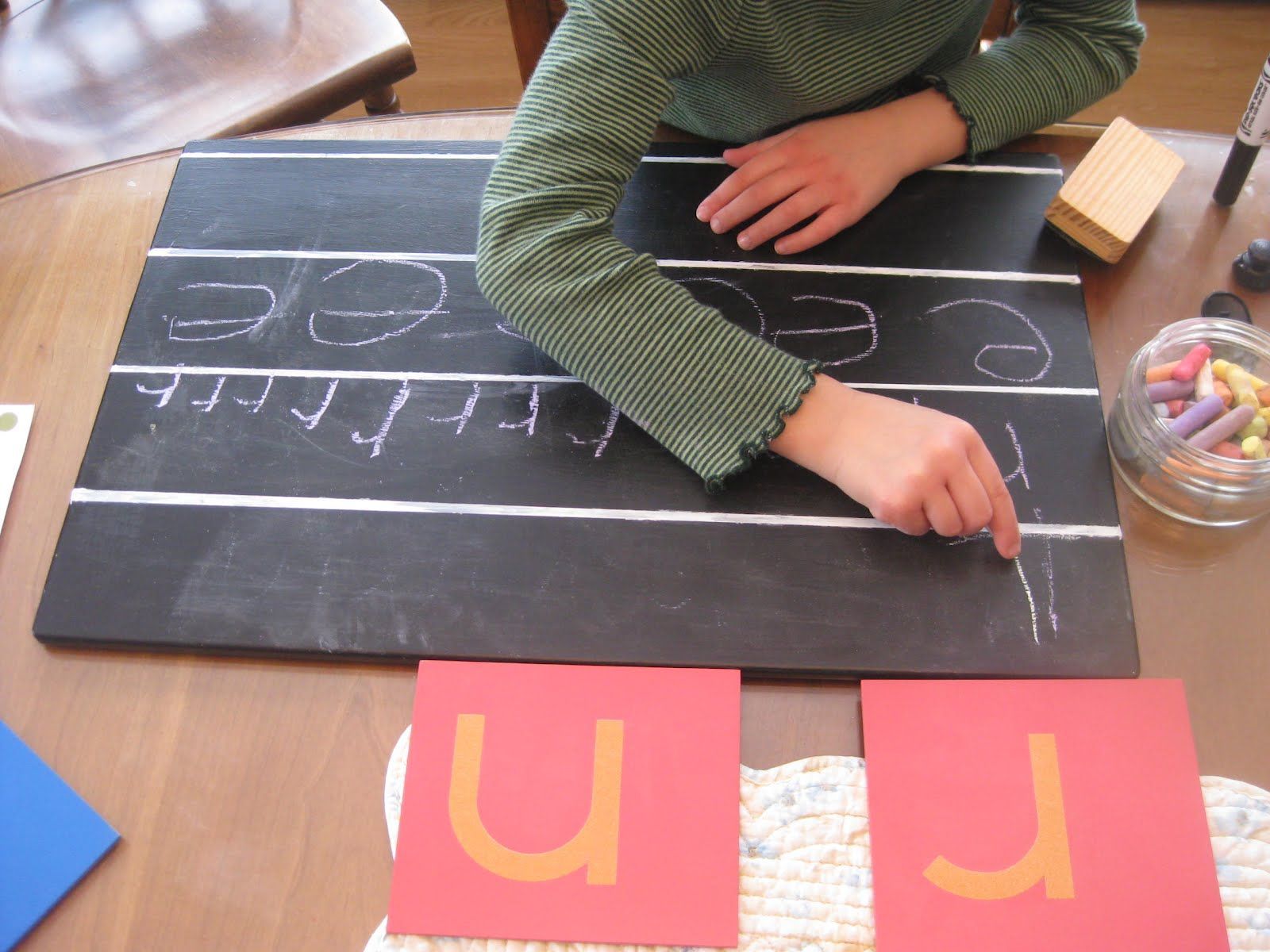
By the time children begin the recording process, that is, writing words on a surface, they have already done enormous preparation. They know the sandpaper letters so well that they can trace them blindfolded or “write” them in the air. They have composed countless words using the Moveable Alphabet, experimenting with sounds and meaning long before their hands are ready for conventional writing.


And then… one day… they are ready to put chalk to board.


This is the beginning of a beautiful and empowering journey.


The Materials That Support the Journey


To help children make the transition from forming words with the movable alphabet letters to recording them on a surface, we offer a thoughtfully prepared environment that can include:


●      Small chalkboards (blank, lined, or squared)

●      Large wall-mounted chalkboards

●      Containers of sharpened chalk and half-erasers

●      A writing supply station with paper in various narrow sizes

●      Pencils and underlays as needed

●      Accessible writing surfaces around the room

These materials invite practice without pressure, exploration without permanence, and repetition without fatigue, all of which are essential at this stage of development.


Step One: Writing Words with Chalk


When a child has composed a list of words with the Moveable Alphabet, the guide gently introduces the chalkboard: “Let me show you something you can do with the words on your rug.”


The child brings one word to the table, and the guide may make a point to notice how the letters connect and flow. With a piece of chalk in hand, the child can attempt to write the word on the chalkboard. For many children, this moment is astonishing, as they suddenly realize, “I can write!”


Over the next several days, the child chooses words, writes them, erases them, and writes again. During this time, the child naturally refines:


●      the direction of writing,

●      the connection between letters, and

●      the placement of letters along an invisible horizontal line.

This is joyful, purposeful work. And the chalkboard provides endless opportunities for clean slates!


Step Two: Introducing the Baseline


Once the child is comfortably writing words, we introduce the idea of a baseline, which is the line on which most letters sit.


We use a simple ruler to draw a single line across the chalkboard and explain: “I’m using this line to show where the letters sit.”


The child thus begins to understand that writing follows a structure, including the realization that letters aren’t merely floating symbols but exist in space in predictable ways.


Step Three: Baseline and Waistline


As the child’s control increases, we add a second line: the waistline. This is the space where most lowercase letters rise up to, and introducing it helps children refine the size and placement of their script.


Using pastel chalk, we shade the space between the baseline and waistline, giving a soft visual guide. Over the next several days, the space becomes a little narrower. And then narrower still.


Eventually, the child works confidently on a nine-lined chalkboard, and from there, we transition to paper. Many children around five-and-a-half naturally begin to prefer writing directly on paper rather than returning to the Moveable Alphabet. They have internalized the shapes of letters, the structure of words, and the flow of writing.


It is important to remember: the natural size of children’s script varies. Some begin writing very small, others larger. We follow the child rather than a rigid sequence.


The ultimate goal is simple and elegant: to write confidently on a single line.


What This Work Supports


A child who moves through this sequence with joy and readiness:


●      develops beautiful, legible handwriting,

●      gains confidence in written expression, and

●      understands that writing is a tool for communication.

This is monumental work for a young child. It marks the moment when their mind and hand unite to express their own thoughts. Most importantly, writing unfolds naturally when the groundwork has been laid with care.


Schedule a tour of our school in Colleyville, Texas to see how we honor this journey with care and intention. 

You might also like
December 1, 2020
Infants and toddlers may be together or separate, with a toddler classroom serving children 18 months to three years. Primary classrooms are for children ages 3-6, with preschool and kindergarten-aged children together. The elementary years serve children ages 6-12; some schools separate into lower (6-9) and upper (9-12) elementary, while many split elementary into two groups. Even Montessori middle- and high-school students learn in multi-age classrooms. While Montessori is not the only type of education that utilizes this approach, it’s not what most people are used to. What are the benefits of structuring a classroom this way? Read on to learn more... Learning at an Individual Pace Children in multi-age classrooms tend to have a little more flexibility when it comes to mastering skills within a specific timeframe. We know that learning is not linear, and that learners have periods of significant growth, plateaus, and even the occasional regression. In multi-age classrooms, children are typically able to work at their own pace without the added pressure of keeping up with the whole group, or even being held back by the whole group. When children in a classroom range in ages, everyone has someone they can work with, regardless of their skill level. Children don’t feel left behind if they struggle with a concept, and they also don’t feel bored by repetition of something they have already mastered. Teachers who teach in multi-age classrooms typically have deep knowledge for a range of developmental abilities, leaving them well-equipped to differentiate instruction for each individual child. Building Stronger Relationships Traditionally children move from one class to the next each year. This means not only a new set of academic expectations, different routines, and different classroom structures, but a different teacher. In multi-age classrooms teachers have a longer period of time to get to know a student and their family, and vice versa. When teachers really get to know a student, they are able to tailor instruction in regards to both content and delivery. They know how to hook a specific child onto a topic or into a lesson. They know what kind of environment a child needs to feel successful. Parents have an opportunity to get to know teachers better this way, too. If your child has the same teacher for two or three years, the lines of communication are strengthened. Parents get to know the teacher’s style and expectations. The home to school connection becomes more seamless, and the biggest beneficiary is the child. Mentors and Leaders When a child spends multiple years in the same class they are afforded two very special opportunities. Children who are new to the class are fortunate enough to be surrounded by helpful peer mentors. Children often learn best from one another, and they seek to do so naturally. First and second year students watch as the older children enjoy advanced, challenging work, and this inspires them. They look to the older children for guidance, and the older children are happy to provide it. After a year or two in the same room, students have a chance to practice leadership skills. In Montessori classrooms, the older children are often seen giving lessons, helping to clean up spills, or reaching out a comforting hand to their younger friends. The best part is kids make the transition from observer to leader in their own time. It doesn’t happen for all children at the same time, but when it does it’s pretty magical to observe. Mirroring Real-Life There is no other area in life in which people are split into groups with others who are exactly their chronological age. Whether in the family, the workforce or elsewhere, people ultimately need to coexist with people older and younger than themselves. Doing so makes for a more enriching environment, replete with a variety of ideas and skills. Why not start the experience with young children in school? Moving On While staying in the same class for multiple school years has many benefits, a child will eventually transition into a new class. While this can feel bittersweet (for everyone involved!) children are typically ready when it is time. The Montessori approach is always considering what is most supportive of children depending on their development. When formulating how to divide children into groupings, Maria Montessori relied on her ideas about the Planes of Development. There are very distinctive growth milestones children tend to reach at about age 3, another set around age 6, and yet another at age 12. The groupings in our schools are intentional, and they give kids a chance to feel comfortable in their community, while also preparing them to soar forward when the time is right.
November 13, 2020
Sometimes it’s easiest to begin by explaining what a Montessori teacher isn’t. A Montessori teacher is less like the traditional idea of an instructor, and more like a gentle guide. They don’t consider it their job to give a child information. They rather lead children in the general direction and give them the tools they need to find the information themselves. Maria Montessori once said, “The greatest sign of success for a teacher...is to be able to say, ‘The children are now working as if I did not exist.’” Montessori Teachers Cultivate Independence In a Montessori classroom, rather than seeing a teacher at the front of the classroom giving the same lesson to every child, the teacher will be working quietly with individual children or small groups. While that is happening the rest of the children are free to spend their time doing the work that calls to them. A Montessori teacher works hard to create structures that allow children to be independent and to trust themselves as learners. One large part of what a Montessori teacher does is to intentionally prepare a classroom environment that is developmentally appropriate, is inviting to children, and supports them on their journey to work independently. This environment is constantly changing in tiny ways as the teacher notices new and evolving needs of the students. Montessori Teachers are Trained to Think Like Scientists Parents should know that Montessori teachers are highly trained. Most have recognized Montessori credentials in addition to their college degrees. Montessori certification programs are intensive and demanding; one might compare them as being the equivalent of another college degree. These training programs don’t just teach Montessori educators how to use the specialized materials; there is extensive coursework about Montessori philosophy, child development, and integrating the arts. When it comes to assessments, Montessori teachers don’t rely on standardized tests; they rely on the power of observation. They have notebooks brimming with evidence of what their students have mastered, need more support with, and are curious about. They are constantly recording what they notice children working on, how that work is being executed, and ideas they might have in anticipation of a child’s next steps. Montessori teachers literally sit beside a child and determine exactly what they know about a wide range of content areas. Montessori Teachers Think Long-Term Because of Montessori’s three-year cycles, teachers have the unique ability to consider their big picture when working with students. There is a natural tendency to allow the children to genuinely learn at their own pace. Getting to know a child and their family well over the course of a few years really supports this approach. Montessori Teachers are Often Called ‘Guides’ ...and for good reason. While children in Montessori classrooms have an abundance of choice in their educational pursuits, Montessori is based on the idea of ‘freedom within limits’. It’s the Montessori teacher’s job to carefully craft those limits. Children rely on having a certain amount of structure in place. This gives them comfort and a safe place in which they can take risks and try new things. Montessori teachers set some boundaries and then carefully help students navigate within them. What if your second grader loves to read but tends to avoid math? Their Montessori teacher will find ways to ensure the math still gets done. Sometimes this involves a gentle discussion with a child about time management skills, priorities, or setting goals. Sometimes the teacher will find a way to integrate the child’s interests into the less desirable work. Sometimes all it takes is a minor change in the environment. Montessori teachers gives children freedom, but they assist children in finding their way to success in this environment. Montessori teachers value independence, self-reliance, and intrinsic motivation. They also value cooperation, kindness, and strength in community. Still curious? Call us to set up an appointment today to observe in a classroom. See what Montessori is really all about.
October 26, 2020
Learning about the planes of development isn’t just for Montessori educators. Understanding your child’s development can help at home, too. The First Plane: birth-6 years During this stage children absorb everything like sponges. They are, indeed, excellent examples if what Montessori called ‘The Absorbent Mind.’ This is a time in which we are able to utilize what Montessori called sensitive periods of learning. While each child is different, there are typical patterns that emerge in regards to brain development and general readiness to learn particular skills. During the first three years of this plane, all learning is done outside of the child’s conscious mind. They learn by exploring their senses and interacting with their environment. During the second half of the plane, from about 3-6 years, children enter the conscious stage of learning. They learn by using their hands, and specialized materials in the Montessori classroom were developed with this consideration. During this time, children have a wonderful sense of order. They are methodical and can appreciate the many steps involved in practical life lessons in their classrooms. The organization of the works on their classroom shelves is intentional, which appeals again to this sense of order. The first plane is a time in which children proclaim, “I can do it myself”; it is a time of physical independence. The Second Plane: 6-12 years During the elementary years children begin to look outside themselves. They suddenly develop a strong desire to form peer groups. Previously, during the first plane, a child would be content to focus on their own work while sitting near others. In the second plane, a child is compelled to actually work with their friends. It is during this time that children are ready to learn about collaboration. During the second plane there is a sudden and marked period of physical growth. This may be a contributing factor to the observation that many children of this age seem to lack an awareness of their body, often bumping into things and knocking things over. Children begin to lose their teeth around this time as well. Their sense of order and neatness tend to fade a bit during this plane. Throughout the second plane, children’s imaginations are ignited. Since Montessori education is based in reality, we find ways to deliver real information to children through storytelling and other similar methods. For example, when teaching children about the beginnings of our universe, Montessori schools use what is called a Great Lesson. The first Great Lesson is a dramatic story, told to children with the use of props, experiments, and dramatics (think: a black balloon filled with glitter is popped to illustrate the Big Bang, with bits of paper in a dish of water used while talking about particles gathering together). This lesson is fascinating for children in the way it is presented, but gives them basic information about the solar system, states of matter, and other important concepts. Children in the second plane have a voracious appetite for information, and are often drawn strongly to what we in Montessori call the cultural subjects: science, history, and geography. While we support their rapid language and mathematical growth during this time, we are also responsible for providing them with a variety of rich cultural lessons and experiences. It is important to note that children develop a sense of moral justice at this time. They are very concerned with what is fair, and creating the rules to a new game is often as important (if not more so) than playing the actual game itself. This is the period of time in which children are striving for intellectual independence. The Third Plane: 12-18 The third plane of development encompasses the adolescent years. During the second plane, children become aware of social connections, but in the third plane they are critical. During this time children rely heavily on their relationships with their peers. They feel a strong desire to remain independent from adults, although they are not quite ready to do this entirely. It is our job to find ways that allow them to experiment with independence while also providing a safe structure in which they may do so. Children in the third plane tend to require more sleep, and they sleep later than when they were younger. They long for authentic learning experiences, and Dr. Montessori imagined just that. Her ideas of Erdkinder (children of the earth) led her to contemplate a school setting that would support children’s development during this time. She imagined a farm school, in which children would work to keep the farm operational, but also contribute to planning and decision making while doing so. During the third plane children are refining their moral compass while developing a stronger sense of responsibility. The Fourth Plane: 18-24 The final plane is a time in which young adults are striving for financial independence. They are often living away from home for the first time, and use this time to figure out where they fit into their society. Many make choices to further their education and/or explore career paths. It is during the fourth plane that people begin to develop a truer sense of who they are as individuals. Each plane of development should be mindfully nurtured. If a child is able to experience one developmental phase in a rich and carefully prepared environment, they are ready to fully take on the next phase when it is time.